

My forest bathing experience
Now with more intention!

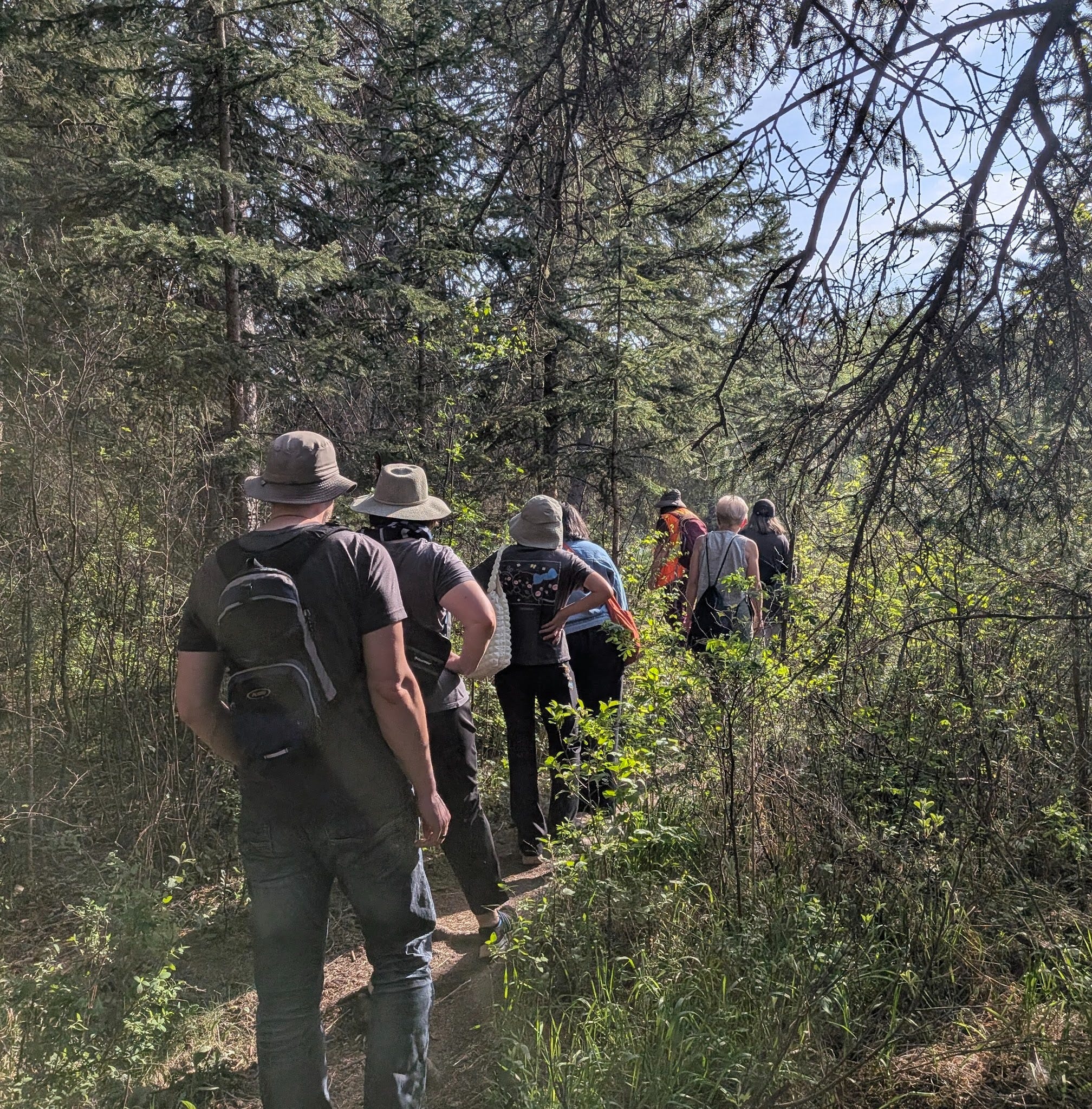
I recently attended a guided session sponsored by the City of Edmonton, where residents learn and participate in forest bathing led by certified Shinrin-yoku practitioners. The city’s program started last year and has grown in popularity. It welcomes folks at all levels of forest bathing experience and includes sensory exploration, meditation, immune system therapy, replanting, tea ceremony, and conservation presentations.
Our host Allyn Esau welcomed us at the entrance to the South Whitemud Creek Ravine on a beautiful May evening. She is a certified Shinrin-yoku guide and a lifelong Edmontonian.
“The term forest bathing and forest therapy are used interchangeably around the practice. Sometimes people hear the term forest bathing and they have some preconceptions, and they’re unsure what that might mean,” explained Esau, as we travelled a short way along the popular path. “It’s more like sunbathing where you’re immersing yourself with intention. At its core it’s about shifting from doing in nature, to being in nature, so it’s really about slowing down and engaging in sensory practices.”
Esau enlightened us that the practice of Shinrin-yoku originated in 1980s Japan, where there was a major shift in how the population reacted to its fast-paced, high-pressure environment — Shinrin (森林) meaning “forest” and Yoku (浴) meaning “bathing.” Coined by the government’s Ministry of Agriculture, Forestry and Fisheries, Shinrin-yoku has roots in Shinto and Buddhist practices where trees are considered spiritual beings with which we are all connected. As we entered we were asked to visualize the Torii, the traditional red wooden gates that mark the boundary between the everyday world and a sacred space.
Veering into one of the many clearings that stem off the path, we paused in a natural seating area where Esau outlined some safety considerations when exploring and touching, including identifying stinging nettle. One thing we didn’t consider that day was the abundance of hungry mosquitoes out early — I encourage future participants to dress or spray accordingly.
Here we took in our first mindful exercise through box breathing, a technique that calms the nervous system and improves focus. It involved breathing deeply into our lungs, holding and exhaling completely through our mouths, with each step given equal time. There is no one right way to be mindful, we were reminded, and you can do this process with eyes open or closed.
Venturing along a well-worn path, Esau explained the many physical benefits of forest bathing, including reductions in blood pressure and heart rate, as well as a decrease in cortisol, the body’s primary stress hormone. Peer-reviewed studies have also shown an increase in natural killer (NK) cells, which aid in fighting cancer. Mentally, a regular forest bathing routine has demonstrated reductions in anxiety, stress and depression that can last weeks. Esau herself confided that she had benefitted as a public speaker from the reduction in anxiety she overcame due to the practice.
Esau pointed out where compounds like phytoncides reach the environment, like the visible sticky sap that flows from wounded points on the tree’s surface. This sap has been sacred to Indigenous healing traditions globally for thousands of years, primarily utilized for its potent antimicrobial, anti-inflammatory and tissue-regenerating properties. She observed that this healing mechanism, although intended to heal the tree, also heals us — we too can “invest in ourselves, and our own individual well being, which in turn can have really broad ripple effects on our surrounding community.”
To take in these benefits we broke away from the group to take our own time deeply exploring our senses in the forest. We listened and observed the birds and insects, touched the trees and the leaves, and smelled and tasted the fragrant spring air. Esau reminded us to respect the animals’ dominion around us and pay attention to signs that we are encroaching on their zones, like birds giving warning that their young are close by.
We were encouraged to try some deeper invitations by touching, tasting and sitting with intention on our own. “Sometimes, it’s as simple as just stopping and changing your perspective — sitting down, laying down and looking up,” Esau said, handing out mirrors we could place in the environment to aid this. I personally enjoyed simply watching the light that filtered through the trees in motion, poetically called Komorebi (木漏れ日) in Japanese.
For another exercise we chose simple instruments like chimes, maracas and tonal wooden blocks to play with on our own. Our host encouraged us to listen deeply or make our own noises to complement the forest soundscape.
As our session drew to a close, we were reminded that forest bathing is not a one-time practice but a continuing relationship with yourself that can develop many forms over time. It can occur in any of the beautiful nature spaces Edmonton provides, or simply through listening to birds in a backyard or park.
My thanks to Allyn Esau and the forest bathing team. Find out more about this city-sponsored program at edmonton.ca. Register early! Sessions fill up quickly.